
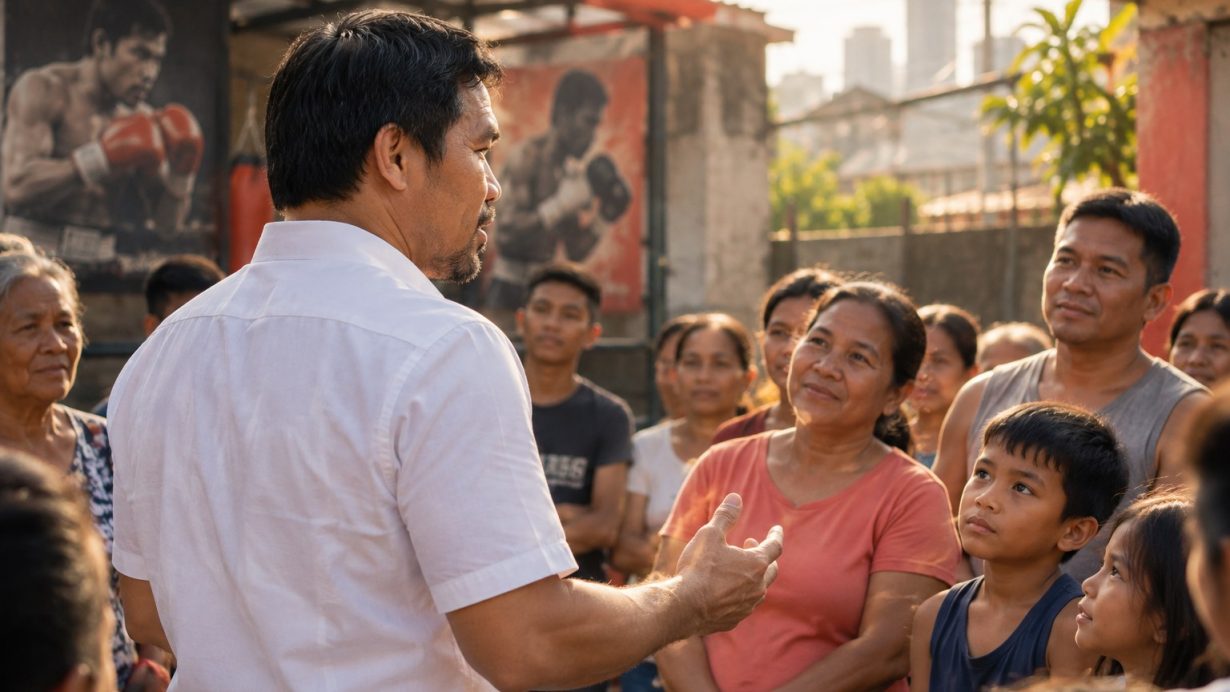
Manny Pacquiao has spent most of his public life being introduced through numbers.
Eight divisions. Twelve major world titles. Knockouts. Pay-per-view buys. Elections. Millions earned.
His newest job comes with a different number attached to it: millions of Filipinos still living in poverty.
On Tuesday, Philippine President Ferdinand Marcos Jr. appointed Pacquiao to lead the country’s National Anti-Poverty Commission, giving one of boxing’s most recognizable figures a cabinet-level role focused on coordinating efforts to reduce poverty.
For a fighter whose personal mythology begins with hunger, street life and tiny purses, it is difficult to imagine a public position more closely connected to the story he has told throughout his career.
From Fighting for Dollars to Fighting Poverty
Pacquiao’s rise has been repeated so often that it risks sounding like boxing folklore.
He grew up poor in the Philippines, left home as a teenager and boxed for tiny purses before becoming one of the richest and most famous athletes the country has ever produced.
Reuters reported that Pacquiao recalled fighting for around two dollars early in his career and sometimes living on the streets. Decades later, he entered the International Boxing Hall of Fame and built a fortune estimated in the hundreds of millions.
That contrast is central to why this appointment will attract attention far beyond normal government staffing.
Pacquiao does not need briefing papers to understand what poverty looks like at ground level. He lived it.
Of course, personal experience is not the same thing as public-policy expertise. Running a national anti-poverty strategy is vastly more complicated than understanding hardship. It involves budgets, agencies, local governments, data and the unglamorous machinery of administration.
That is where the real test begins.
A Different Kind of Pressure
Boxing offers a wonderfully simple definition of success. Two fighters enter a ring. Judges or a knockout usually determine who won.
Government is nothing like that.
Pacquiao will be working in a country where poverty remains a major structural challenge. According to Reuters, the Philippine poverty rate stood at 9.7 percent in 2025, representing roughly 11 million people. The Marcos administration wants to reduce that rate further by 2028.
There will be no single night where Pacquiao can solve that problem with one left hand.
Progress will be incremental, politically contested and difficult to measure in ways that satisfy everyone.
For an athlete accustomed to visible results, that may be the biggest adjustment of all.
Pacquiao Has Never Really Stayed in One Lane
None of this should be surprising to anyone who followed Pacquiao beyond boxing.
Even during his fighting career, he was never simply a fighter. He became a congressman, then a senator, and eventually ran for president in 2022. His political ambitions were not a retirement hobby added after the punches stopped. They developed while he was still competing at elite level.
That created an unusual public identity.
In most countries, a superstar athlete entering politics is treated as a novelty. In the Philippines, Pacquiao spent years moving between training camps, legislative duties and enormous fights as though those worlds naturally belonged together.
Sometimes the arrangement drew criticism. Politics requires attention, and so does professional boxing. Trying to do both at the highest level inevitably raised questions about whether either job could receive everything it demanded.
Now the boxing schedule is no longer the central obligation.
That gives this role a different feel.
His Boxing Legacy Is Already Secure
Pacquiao has nothing left to prove as a fighter.
His career stretched across generations and weight classes in a way that may never be replicated. He began as a tiny, raw southpaw and eventually fought elite opponents at welterweight, collecting championships across eight divisions along the way.
The names on his record read like a history of an era: Marco Antonio Barrera, Erik Morales, Juan Manuel Marquez, Oscar De La Hoya, Ricky Hatton, Miguel Cotto, Shane Mosley, Floyd Mayweather and Keith Thurman.
He was not undefeated. That was never the point.
Pacquiao’s greatness came from the scale of the risks he repeatedly accepted. He moved through divisions, fought dangerous opponents and developed from an explosive puncher into a far more sophisticated boxer without losing the chaos that made him exciting.
His Hall of Fame induction in 2025 simply formalized what boxing had understood for years.
The Comeback That Reminded Everyone Who He Was
Even retirement did not completely separate Pacquiao from the ring.
After initially retiring in 2021, he returned in 2025 for a WBC welterweight title opportunity, an extraordinary proposition for a man in his mid-40s.
The comeback reinforced something familiar about Pacquiao: conventional limits have rarely interested him.
That trait can be admirable in boxing. Whether it translates effectively into government is another question.
Public administration rewards patience, coalition-building and detail. Fighters are trained to impose themselves. Political institutions often resist exactly that.
Pacquiao will need more than celebrity and good intentions.
Why This Matters to Boxing Fans
There is a tendency to stop caring about athletes once they no longer produce fights.
Pacquiao makes that difficult.
He is one of the clearest examples of how boxing can alter the trajectory of an entire life. The sport took a teenager fighting for survival and turned him into a global celebrity with enough influence to sit at the highest levels of national government.
That does not mean boxing automatically prepared him for the job. It means the distance between where he started and where he now sits is almost absurd.
For young fighters in the Philippines, Pacquiao remains both inspiration and impossible comparison. Every promising Filipino boxer is still measured against him, even though expecting another career like his is unfair.
There may never be another eight-division champion.
There certainly will never be another first Manny Pacquiao.
The Hardest Opponent Cannot Be Knocked Out
Pacquiao said after the appointment that his own experience of poverty gives him a responsibility to help people facing the same circumstances.
The sentiment fits the public image he has cultivated for decades. Pacquiao has long been known for philanthropy and for distributing money and assistance directly to people in need.
A national commission is different.
Charity can help a person immediately. Policy has to change the conditions producing the problem in the first place.
That distinction will determine how this chapter of Pacquiao’s career is judged.
He has already beaten champions much bigger than the teenager who first entered a professional ring. He has already won elections, lost an election, returned from defeats and rebuilt himself repeatedly.
Poverty is not an opponent that can be intimidated at a press conference or finished before the final bell.
It may be the most difficult fight associated with Manny Pacquiao’s name.
And for millions of Filipinos, it matters considerably more than any belt he ever won.