

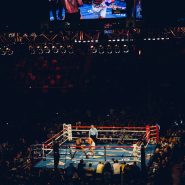

Sometimes the numbers tell the story better than any tribute can.
More than 82,000 people inside Croke Park. A peak television audience of around 1.6 million in Ireland. Roughly another half-million streams through RTÉ Player. More than 150 million social-media impressions surrounding the event.
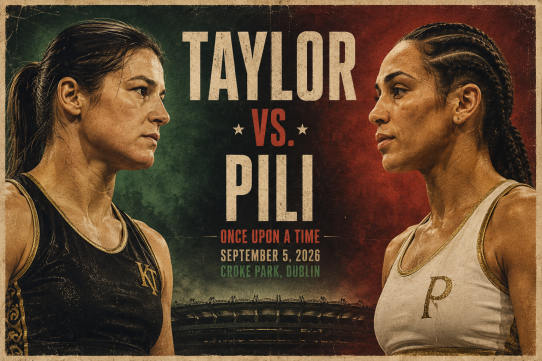
Katie Taylor’s farewell was already an extraordinary sporting moment when she placed her gloves down after defeating Flora Pili on Saturday night.
The viewing figures released afterward made something else clear.
This was not simply a big women’s boxing event. It was one of the biggest sporting events Ireland has produced.
The Perfect Ending Is Rare in Boxing
Boxing is not particularly good at farewells.
Great fighters usually stay too long.
The competitive instinct that made someone capable of becoming a champion is often the same instinct preventing them from recognizing when the career should end.
Taylor avoided that trap.
At 40 years old, she entered Croke Park knowing exactly what Saturday represented.
There was no comeback tease attached to the occasion. No vague suggestion that another fight might happen if the right offer arrived.
This was goodbye.
And Taylor delivered the performance the occasion demanded.
Against previously unbeaten Flora Pili, Taylor controlled the contest and won a clear unanimous decision, with scorecards of 100-90, 100-90 and 98-91.
She finished her professional career 26-1.
More importantly, she finished it as an undisputed champion.
Few fighters get an ending that clean.
Croke Park Meant More Than Another Stadium
The venue was essential.
Taylor could have staged her final fight in Las Vegas, New York or another major boxing market and generated a substantial payday.
It would not have meant the same thing.
Croke Park transformed the fight from a boxing event into a national sporting occasion.
Elite boxing had not been staged there since Muhammad Ali fought Al Lewis in 1972.
More than half a century later, Taylor returned boxing to the stadium with herself at the center of the spectacle.
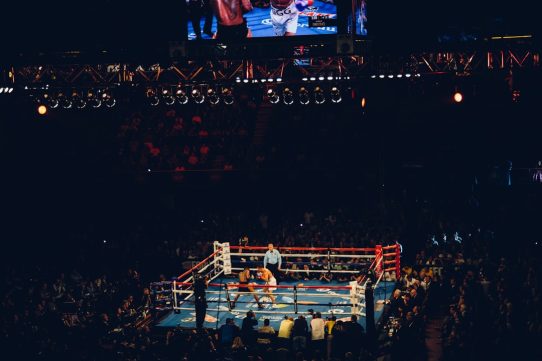
According to Matchroom, the crowd exceeded 82,000, making it the largest attendance ever for a boxing card headlined by two women.
Think about how dramatically women’s boxing has changed for that sentence to exist.
When Taylor began boxing, female participation in the sport barely had an established pathway.
By the time she retired, more than 80,000 people were willing to fill Ireland’s most famous stadium specifically to watch her fight.
That transformation is part of her legacy.
The Television Numbers Are Remarkable
The stadium attendance was visible immediately. The television impact only became apparent afterward.
Matchroom reported that RTÉ’s free-to-air coverage reached approximately 1.6 million viewers, while the program averaged 973,000 viewers and captured around 74 percent of the available television audience.
Another roughly half-million streams were recorded through RTÉ Player.
Those are extraordinary numbers in a country with a population of just over five million.
Taylor effectively turned a boxing match into communal viewing.
People who rarely watch boxing watched. Families watched. Casual sports fans watched. People who had followed Taylor since her amateur career watched.
That crossover appeal is incredibly difficult to manufacture.
Promoters can spend millions advertising a fight and still never create it.
Taylor built it over decades.
From London 2012 to Croke Park
Taylor’s Olympic victory in London remains one of the defining moments of her career.
But her professional career expanded what was possible for women’s boxing commercially.
Madison Square Garden became part of that story through her rivalry with Amanda Serrano.
The pair’s first fight in 2022 became the first women’s contest to headline the main arena at Madison Square Garden.
Taylor then continued collecting major fights, championships and audiences.
By the end, the idea of a woman headlining an enormous boxing event no longer felt experimental.
That may be Taylor’s most significant contribution to the sport.
She did not simply participate in women’s boxing’s growth. She helped normalize it.
What Happens After a Superstar Leaves?
Women’s boxing now faces an interesting question.
What happens when one of the athletes responsible for creating the current market leaves it?
There are excellent champions throughout the sport.
Claressa Shields remains one of boxing’s most accomplished fighters. Amanda Serrano has her own enormous following. A new generation continues emerging internationally.
But Taylor occupied a unique position.
She could turn an entire country into a boxing audience.
Replacing that is impossible.
The more useful objective is building upon the audience she helped create.
Every young girl who watched Taylor at Croke Park now understands that boxing can lead to something previous generations could barely imagine.
Not merely championships. Not merely Olympic medals. A packed national stadium.
The Business Lesson From Croke Park
There is another lesson boxing should take from Saturday.
Authenticity sells.
The event worked because Croke Park meant something to Taylor and to the people buying tickets.
The industry sometimes assumes bigger markets automatically produce bigger events. That is not always true.
A fight becomes special when the location, fighters and audience are connected.
Taylor fighting her final bout in Dublin provided exactly that.
The emotional investment could not have been replicated simply by moving the same card to a more commercially convenient arena.
Promoters should remember that.
Boxing’s best nights often happen when the sport stops chasing the largest theoretical market and instead goes somewhere the fight genuinely matters.
26-1 and Finished on Her Own Terms
There will be plenty of debate about Taylor’s exact place among boxing’s greatest women.
Those arguments are part of sports.
What cannot seriously be debated is her influence.
Olympic champion. Multiple-weight world champion. Three-time undisputed champion. Madison Square Garden headliner. Croke Park headliner.
And ultimately a fighter who helped move women’s boxing from the margins of the sport into arenas promoters once assumed it could never fill.
The final image was almost too perfect.
Taylor, surrounded by more than 80,000 people in Dublin, leaving her gloves behind and walking away as champion.
Boxing rarely writes endings that well.
Katie Taylor managed to write her own.